Friday, August 10, 2007

Summer Morning Ride


Summers in Egypt are hot. By 11 am it's often over 35 Celsius or 95 Fahrenheit and still on its way up. We have a farm rule that horses don't work in temperatures over 35 C because with the humidity, it adds up to a heat index that spells cooling difficulties for the horses. Yesterday I was up at 7 am to take one of my mares out for some exercise before it got too hot. We have some standard trails that include good areas to stretch with a canter as well as narrower sections that have to be ridden more slowly. Stella and I headed out in the cool morning air but very soon discovered that we were not the only ones taking advantage of the early hour. The paths were crowded with farm families walking out to the fields with their water buffalo and with farmers who had been harvesting fodder for the animals since dawn.

If we weren't going to be able to move quickly for fear of frightening animals, we could at least amble along and enjoy the early morning so I dug out my trusty Nokia 6630 and decided to take some photos along the way. Mobile phones are used everywhere by the farmers since there are so few land lines out here, so taking a photo with a phone attracts much less attention than a camera might and I was able to shoot some scenes of early morning life in the countryside.

Many places have watchmen who guard at night. Sometimes they have a little room by a front gate, but a restaurant on our track has its watchman sitting across the road at night. He spreads a blanket inside a shelter in the winter, but summer nights are wonderful outdoors and I could see this blanket still in its place.

As we turned down another track, we came upon a canal where a flock of little egrets were hunting frogs, minnows and crayfish. Horses don't usually bother the birds nearly as much as a person on foot would, but we must have made some noise to startle them because they all took flight in a flurry of snowy feathers. They only were airborne for seconds before they resumed their hunt for food in the canal. I guess we weren't so scary at second glance. Crows gazed down calmly on us from mulberry trees while bee eaters rested from their labours on the electric lines and kingfishers flashed turquoise along the canals.

The last stretch on our way home led us through one of the small villages on the main road. On the other side of the canal, the sand trucks were lumbering along the asphalt road, but our path took us along a dirt road lined with colourful fellaheen homes where families were sitting on mastabas in the morning sun having breakfasts of beans and bread or eggs with cheese and bread. Woman had been up early taking care of washing and other household chores, while the men had gone to the fields or to work and would have their breakfast brought out to them by one of the women or children.

Breakfast provides the village women and children with a chance to make a bit of money as well. Ta'ameya or felafel is a traditional Egyptian breakfast that takes rather a lot of time to prepare. Fava beans must be soaked for a day or two and then ground to a paste with onions, garlic, and herbs. This dough is then mixed with an egg and some baking soda, and then fried in oil. Most villages have one or two women who are willing to do all of this, allowing the others to buy. It often seems that the job rotates among the households in an area, giving various families the chance to earn cash while relieving others of the labour. The wonderful smell of the frying patties was enough to hurry our steps home for our own breakfast.

copyright 2007 Maryanne Stroud Gabbani

Tuesday, July 10, 2007

Farewell To A Warrior

We lost a good friend yesterday morning. Aybek, my friend Cristina's little black gelding, died of a brain hemorrhage just after dawn. It was sudden and painless, as we could all wish for our horses, but the timing was way off. He was only about five and a half years old. We know more or less when it happened because the water buffalo gave birth to a daughter in the early hours of the morning and the grooms were running back and forth to check on them next to the horse paddock. Just about dawn they gave everyone some hay and all the horses were happily chomping away, but an hour later when they checked Aybek seemed to be taking a nap in the paddock. A nap at this hour would be sufficiently odd that they checked and found that he was dead. No sign of rolling or thrashing, he simply lay down and died. Cristina is in Italy on holiday with her family as is usual in July, so we arranged burial in the gravel pits.

Aybek was named after a famous Mameluke warrior by a neighbour of ours who was dispatched to rescue him from a Red Sea resort when his European owner had to leave Egypt suddenly. He was a tiny two year old black stallion at the time, so he was left to grow, hopefully, into his name. He never got very tall, being just 14 hands, but his conformation was lovely. He was a very nicely put together horse, just a bit smaller than average. The neighbour moved him to my place when he was about four and we gelded him, which was a very good thing. While he may have been small, he was a mighty warrior and was constantly challenging all the other horses to battle. Aybek was the perfect example of how a nice stallion can become a great gelding. Cristina, who isn't such an enormous person herself, began riding him not long after he'd recovered from the surgery.

Aybek proved to be a remarkably calm youngster. We worked him in the countryside at first to give his muscles and tendons a chance to toughen a bit. He never spooked at the scariest of things along the way and would cross ditches, step over the feed pipes to running diesel water pumps, and even walk past camels who were rising from rest in their strange stair-stepping fashion as long as an older horse showed the way at first, and later he would lead the way past. Cris had never trained a horse before, but her patience and firmness and obvious affection for her little guy was just the trick and he gave her all his trust in return. Training him to allow other horses to walk along behind and next to him wasn't always easy but he had learned to allow others in his space and could be counted on to behave politely when the trail got crowded suddenly, a far cry from the mighty midget warrior who had to take on the world when she started. It was a wonderful thing to watch the two of them growing and blooming with confidence and ability together. They had a true partnership.

One of the things about working with horses is the fact that they are significantly bigger and stronger than we are, even the little ones are. It isn't very easy to force a horse to do something that he/she really doesn't want to, so a rider really must rely on the willingness of the horse to cooperate with him and to help him achieve his end. Finding a horse that you can truly trust and who trusts you is a gift. Cristina and Aybek had this gift. She will have another horse to ride, but what she built from the ground up with Aybek will never be surpassed.

copyright 2007 Maryanne Stroud Gabbani

Saturday, June 30, 2007

Pyramid Navigation


Trailriding as done in most places involves trails that have beginnings and endings and sides that define what is "on the trail" as well as what is "off the trail". Egypt has trails like that in the farming areas. They usually wind along canals and next to fields. They vary from about 10 cm in width to decent dirt roads for cars depending on what kind of traffic uses them...donkeys, carts, horsewagons, or pickups.

These trails are great fun for riding, especially in the summer when the sun hitting the sand in the desert reflects back up at you like a blast furnace. The valley dirt is darker and absorbs the sunlight, while the trees offer shade and the canals give up moisture to soften the heat. The downside of riding trails in Egypt is that you can't really predict what you are going to meet. Perhaps the trail will have a small valley across it filled with runoff from a field next to it being irrigated. Initially a 10 cm ditch filled with running water might as well be the Grand Canyon for most horses. With practice they learn to jump the ditches or even (will wonders never cease?) step over them. There are also extremely threatening objects and creatures to be passed. A diesel water pump racketing away next to the canal and jetting forth a column of water almost 10 cm across and extending out for a metre and a half is definitely a reason for most horses to stop and goggle for a bit. Fortunately, most times the water column is not directed across the trail but along it and into a concrete well to flow under the trail in a pipe. When the water is blocking the trail, the farmers are generally willing to turn off the pump for couple of moments so that they horses can pass...though convincing novice mounts to walk through mud and water and next to the previously noisy monster can be lots of fun.

With all of these hazards to deal with in the farming areas, it really is not surprising that most riders prefer to go riding out in the desert. Our desert is most convenient in that there is nothing at all to spook the horses. There are no trees, no buildings, no human activity, no roads. Even the wild dogs and the foxes tend to avoid riders so there you are in the world's largest arena all by yourself. But this brings up a new issue. How do you navigate? Sailors out in the trackless oceans must take note of the stars to determine where they are, so what do riders in the Sahara do? Well, obviously...we navigate by pyramids.

So we venture out into the sands from the valley, and if as sometimes is the case early on a winter morning, there is fog, we can be in big trouble. The desert in this area can occasionally be foggy enough to hide even a pyramid, and I once found myself at a ruined house on a plateau a kilometre from the watchman's shack next to the pyramids of Abu Sir that I'd been aiming for.
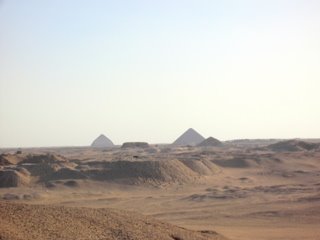
Assuming that it isn't that foggy, the first landmarks are the pyramids of Abu Sir, which are visible quite clearly from the valley.

Once past the pyramids, the desert spreads before you and the next good landmark is an outcropping of the plateau known as the Japanese Hill. It acquired this name due to the fact that the Japanese have been coming here every July for about the past twenty years to excavate a temple near the base of the hill and what seems to be a lookout post on the top. From the top of the hill you get the best view of the desert available. To the north can be seen the the three huge pyramids at Giza, if the haze isn't too thick. Just below lie the pyramids of Abu Sir and its Sun Temple just north of the pyramids. Southwest can be seen the Step Pyramid at Sakkara and the many other mostly ruined pyramids stretching south along the valley with its seagreen palm groves. Finally to the south, lie the pyramids at Dahshur, the Red Pyramid, the Bent Pyramid, and off next to the lake, the Black Pyramid.

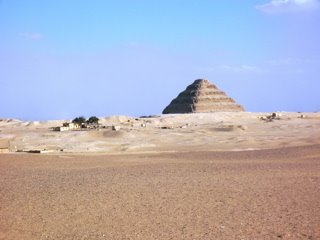
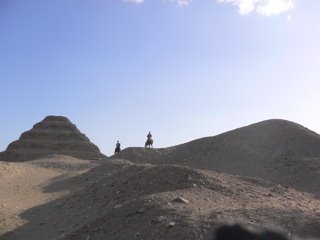
As we make our way down the hill, the Step Pyramid is our first landmark, to be kept to the left. With so many archaeological teams digging in Sakkara, the Antiquities Council is a bit nervous when riders wander too close to the area, so we stay about half a kilometre in from the excavation areas. The desert isn't flat so from time to time we find ourselves in a hollow area from which we can't see any pyramids, so the best thing to do is to make our way to high ground from which we can again get our bearings.

Just south of the Step Pyramid there is just such a rise, from which Mastabat Pharaon (the Pharoah's Mastaba or bench), a birthday cake-looking structure can be seen to the south past a couple of wadis. Next to it is the pyramid of one of the Pepi's, of which there are quite a few at Sakkara. To the right and about five kilometres on can be seen the Red Pyramid at Dahshur with the Bent Pyramid in the haze behind it. Because everything is more or less the same colour and there are no normal sized objects to use for reference, it's very difficult to judge distance, and hills just sort of blend into each other, hiding the wadis. Between Mastabat Pharaon and the Red Pyramid, for example, lies a wadi (valley), some hills, a railway track that leads to Fayoum with our favourite sarcophagus, more excavations, a natural gas pumping station, an asphalt road and quite a lot of desert. None of this is obvious from the view by the Step Pyramid, so we take a sight on the Mastaba and then aim for a spot left of the Red Pyramid to find the sarcophagus marking the crossing point on the railway tracks. The next section of the trip is a bit difficult because there is a fence that runs across the route we want to take to the Red Pyramid. I'm not sure who built it, the army, the gas company, the Antiquities Council?...but almost immediately upon it being built someone had very effectively cut a couple of holes in it sufficient to drive a jeep or ride a horse or camel through. Egyptians don't really like fences. With practice, finding the hole is not that difficult...it's the only section of fence without a layer of plastic bags stuck to it...and we make our way into the Dahshur section of the ride. Because the Antiquities Council takes a dim view of people entering its sites without a ticket, and because the entry office won't sell tickets to people on horseback, we usually give the Red and Bent Pyramids a miss, admiring them from afar, and head to the Black Pyramid next to the lake.

This pyramid was built of millions of mud bricks, about half of which survive today. It doesn't look much like a pyramid, actually, more like an upended, half melted ice cream cone, one of the old kind with the flat bottoms. As we approach from the desert, the pyramid's bulk hides the lake bed behind it, but as we move around it the green of the lake bed comes into view and the horses are pleased. There's usually a rest stop by the lake, a drink, a snack and then one of those nice things that come in handy every so often....a trail through the palm groves to take you home.
copyright 2007 Maryanne Stroud Gabbani

Sunday, May 06, 2007

Trail Marking - Desert Style

There is a relatively new sort of equestrian sport, or a group of sports really, known collectively as distance riding. Some of them are done fast over distances from 25 to 100 miles (endurance riding), others are done slower over distances (competitive trail riding)...but the thing that they have in common is the fact that someone has to go out ahead of time to set out a trail that the other riders have to follow, sort of like an equestrian game of hare and hounds. In places where there are trees and things, a favourite marking strategy is to tie surveyor's tape to tree limbs, but where we ride, in the Sahara, there are no trees, no bushes, no grass, no nothing. The first few rides were marked with flags on poles that had to be planted in the desert and then collected quickly after the ride before someone else collected them to use in some other way. This was a major pain as well as being pretty expensive. Then one day someone got the bright idea of using powdered gypsum to mark our trails.

So now we go out into the desert, scout out an interesting trail, hopefully one that includes some changes in elevation along with twists and turns, we measure it by odometer and gps and then return the day before the race to mark it. Pouring out spots of powdered gypsum in a windy desert is a real treat. Happily, I own the gps, so I ride in the lead car checking distances and waypoints to make up a map for the riders. A neighbour has a vehicle that vaguely resembles a Jeep wrangler missing most of its doors and the roof. He drives the gypsum car. We've found that it takes about 8 bags of gypsum to mark 20 km of trail. For shorter rides, we make a 20 km loop that is ridden clockwise the first loop and counter-clockwise the second loop, creating a 40 km (25 mile) track.

One of the ways that we've found to make a trail more challenging is to take it up the hill from the valley to the quarry area where the sand and gravel miners have been working for the past ten years making odd shaped holes of various sizes and connecting these holes with rough tracks made by trucks, jeeps and heavy earth moving equipment. Some of the riders found this area a bit daunting at first, but I suspect that it gives the horses' legs a bit of a rest from the softer sand in the rest of the desert. Following white dots on the ground along tracks that loop and twist around piles of sand and holes of varying depths (right up to/down to about 150 metres) on a horse can involve some pretty intense attention, and it does tend to slow the riders down a bit. The goal in marking is to have enough marks that the trail is not confusing (it can't cross itself, obviously) but not so many that people are just following a white stripe through the desert.

One of the challenges of laying trails through the quarries is the fact that the miners often work at night, so the trail that you see one day may not exist the next day. We've found through trial and error that they usually don't work on Thursday nights or on Fridays, so a trail laid on a Thursday afternoon is safe until Friday during the day. However, there are usually frequent stops on the marking pass to make sure that the trail measured on Wednesday is still there. The entire process takes about three hours with all the stops...more time than it usually takes to ride if you are moving fast on a well-conditioned horse.

The trail that we marked this particular day ran for about 6 km through the quarries closest to the valley, descended a hill into a wadi, which we crossed and then passed over another low hill to a second wadi where a truck with water for horses and riders waited. Some of our horses were interested in the water, but many weren't on the first loop. When we rode the trail the next day, the weather was perfect...cool, clear and just windy enough. The long wadi stretches of the trail tend to encourage the horses and riders to really move out. FEI endurance races here are almost entirely flat wadi riding and are very fast. The footing on these stretches varies from soft sand to sand covered with flint pebbles ranging in size from large grapes to grapefruit. The pebbles sink into the sand when the horses step on them, so stone bruises aren't really all that common happily.
Over all, the track was about 50% wadi and 50% quarries, giving everyone a chance to slow down and think as well as to simply zoom. The quarry portions were fun to ride and there were moments when the riders would suddenly come up to the edge of a hill from which they had a clear view of the pyramids of Dahshur or Sakkara. Not having any vegetation to change the view during the ride, we have to make due with closing in the vision and then opening it up. With practice, we are getting better. Now we just have to hope that our marking crew survive. A mask to keep the gypsum out of the lungs of the pourer helps as does a good hot shower after the work.

copyright 2007 Maryanne Stroud Gabbani

Saturday, April 14, 2007

Sharing the Japanese Hill


Sometimes Christmas holidays are my busiest time, but this year everyone decided to come for Easter. Easter holidays in Egypt are especially fun because we have three of them usually within 10 days of each other, first the western Easter Sunday, then the Coptic Easter Sunday and the day after that, Sham el Nessim, the ancient pharoanic spring holiday that is celebrated also with coloured eggs and such. This Easter also brought me some old friends who wanted to share part of their experience of Egypt on horseback with some new travelers.

The day had started out most inauspiciously with a bang-up sandstorm and winds out of the southwest, the southern western desert. I'd gotten a phone call from a family from Cyprus who were visting for Easter. They'd been riding at the pyramids of Giza and had not been happy with the experience, so when someone recommended me, they thought they'd try again. Horseowners themselves, they weren't put off by the weather even when I warned them that it would be an experience somewhat like being sandblasted. We went out into the desert for about half an hour where we found a rather forsaken group of tourists on camels and horses who had obviously started out when the weather was good in the morning and were wearily making their way back in the dust. Once my Cypriot clients were safely headed back to the city, I worried over the weather for the afternoon ride, which included two young Belgian girls who were new to Egypt.

The ride was organised by my friend Nathalie and her daughter Pauline, whose friends were the novice riders. It was the girls' first trip to Egypt and they'd spent the week with friends of Pauline's learning first hand about the life of teenagers in Cairo. Annabel and Laura arrived at the farm with Nathalie and Pauline, tired from a busy social schedule but game for more experience. Fortunately by then the winds had dropped and we were not going to be blasted by blowing sand.

We put the girls on two of the trusty geldings, Aybek and Bunduq, gave two of the grooms lead lines to ensure safety, and set off for the desert about 4:30 pm. The shock of the transition from the green fields of the valley to the bare desert set the girls aback, much to the delight of Pauline who admitted that this was really the only way for anyone to really understand the contrast. Explanations simply don't do justice.

We rode out towards the new Czech excavations behind the Abu Sir pyramids and I showed them one of the old shaft tombs, happily surrounded by an old stone wall so that we could admire the hole without worries of falling in. Then we went on to the Japanese Hill, which has to have the best view of pyramids in the entire world. From the top of this little outcropping one can see, on a clear day which unfortunately this wasn't really, all the pyramids from Giza to the lake at Dahshur. This is one of the best ways of realising just how many pyramids Egypt has.

From the top of the hill, the descent to the desert below is a steep climb down a sandy slope, prompting tips to our novice riders to recall the hill scene from The Man From Snowy River...but they not being horse nuts hadn't seen the movie, so the tips were pretty worthless. At the bottom of the hill, Pauline, Nathalie and I sent the girls on a quiet direct route to our exit from the desert, while we roared off in another direction to have a gallop around the area before meeting them again in a couple of minutes. We cantered past a number of village football games in the sand at the edge of the desert and rejoined the group to amble back to the farm along canals and past water buffalo and weary farmers.

At one point in the ride, Pauline took my camera to immortalise some of the moments of the afternoon, taking in the process a series of fairly hysterical mugshots. Only Pauline would be riding across the desert while staring into the lens of a camera. Back at the farm, the girls clambered off the horses on stiff legs, but gave their mounts big hugs despite the promises of even more stiffness the next day. Both of them said that the experience was definitely worth any stiffness as now they could understand the stories that Pauline had been telling them all year about her riding weekends while living here in Cairo. Nothing like sharing experiences.
copyright 2007 Maryanne Stroud Gabbani

Sunday, February 25, 2007

Ghost Riders In The Fog


Last Friday our local riding group had a 40 km ride...in the fog. Spring weather in Egypt is as changeable as it is in other places and while it was clear when we got up to feed horses at 5 am, by 6:30 you couldn't see more than about 20 metres. Our ride was in the desert, an area not known for its landmarks at the best of times, so this looked to be an interesting experience. Seventeen horses and riders gathered at Dr. Ali Abdel Rahim's stud farm at the edge of the desert for the start. Horses were checked by local vets to be sure that they were ready to go, we were given a quick briefing, told to follow the splashes of white powder in the desert and then given leave to depart.
The trail led from the edge of the farmland up the hill to a plateau that is used by the sand miners who excavate sand and gravel there, leaving winding trails around holes and hills of unclaimed gravel. From the starting point though, the plateau couldn't even be made out. The usual riders in more of a hurry moved off quickly, but Cristina and I took our time along with a couple of other women who were new to the group. We ride in the desert here all the time so the likelihood of our getting lost in the fog was fairly low, but the other pair were strangers and we were a little concerned.
The horses moved off happily up the hill. I was riding Dooby a 7 year old gelding who has an enormous fast walk and long legs that dwarf those of Cristina's gelding Nayzak who is rather slight but very fast. Small as he is, Nayzak is faster than Dooby when we let them really move out, so they are actually very well matched. The other two women were riding horses that walked so slowly it was rather painful. On one hand the trail was marked, but not all that well and Cristina and I felt rather guilty just riding off into the fog and leaving them.
The faster riders had taken off quickly leaving us with an empty desert spotted randomly with some hoofprints, the odd tire track and some white powder. Over the plateau, the trail followed some dirt tracks and the trick was to spot the spot that showed whether to turn right or left, but about 8 km into the track, the trail came out onto a wide open space where the riders could have taken any direction. This part of the track was one that had us a bit confused because we were coming into a familiar wadi from an unfamiliar point, and with the still clinging fog, it was hard to get our bearings. We trotted on, checking behind us for the other women every so often, figuring that at least they could get an idea where the trail went by seeing us in distance.
As we circled one of the flat tabletop hills at the end of the wadi to head south to the homeward stretch of the trail, the sun began sneaking through the fog and the landscape was much easier to make out. We stopped worrying so much about the newcomers following us and let the boys out to stretch their legs. The leaders were just cantering along merrily quite a ways ahead of us; we had no concern that we might catch up. In fact on the way in Cristina did some quick calculations on time and realised that she wouldn't be able to go out for the second loop because she had to meet her family for a lunch later and the time would simply be too short. Having decided that we wouldn't be doing the second loop, when we ran into an old friend on the trail who wasn't in the ride, we stopped to chat much to the confusion of the two women who had been following us up to that point. Well, it was all about fun anyway.

We did warn the organisers that they were going to have to get either a drag rider to keep tabs on the last riders or someone in a jeep starting from the next ride. Cristina and I have been bringing along some horses and monitoring their recoveries and this was the last checkout ride. Dooby has an irregular heartbeat and can't be relied on to recover properly to the needed 64 beats per minute despite the fact that he loves the competition and can cruise happily for ages. Nayzak, on the other hand, drops to 40 beats per minute quickly, making him a good partner for either Nazeer or Bunduq. Next time, no last place for us.

copyright 2007 Maryanne Stroud Gabbani

Tuesday, October 24, 2006

Finding the Sarcophagus


Some friends are so special that everything you do with them is infused with light and joy. I've been very blessed in my life with a number of these friends and just recently had the pleasure of being able to spend three hours wandering in the desert on an afternoon of intensely clear light taking fun pictures and looking for a sarcophagus with one very wonderful one. Nathalie was in Cairo for about three or four years and I had the very good luck that she found herself at a gathering with another friend of mine a year or so into her stay. She was looking for a place to go riding with her daughter and I was recommended. This was the beginning of a weekly treat for me, as each Saturday morning she and Pauline would come out to the farm and we would go exploring or just whooping it up through the countryside and desert. One of the painful things about living in Egypt is the fact that unfortunately many of our people are transient, and Nathalie and Pauline moved back to Belgium this summer. They did, however, leave me a souvenir in the person of their cat who needed to be boarded for a couple of months until Nathalie could return to pick her up. Last week was the pick up.

We arranged to go out for a ride in the desert (Belgium is a little short on deserts so some sand time sounded good to Nathalie) and headed out around mid afternoon. We took two of the geldings, Nayzak for Nathalie and Pauline's special love Dooby. It was one of those breathtakingly clear days that we get once the heat and dust of summer begin to dissipate and we were delighted that I'd thought to bring my camera along. We headed south towards Sakkara marvelling at the intensity of colour and clarity that allowed us to see all of the pyramid fields from Giza to Dahshur. Generally it's possible to make out the Red and Bent pyramids in Dahshur if you know where to look, but on this day they were simply THERE. It's hard to determine distance on days like this because the air is so clear that details of distant objects are easily visible...but then again on a day like this it's really hard to worry about little things like time and distance.
I can't say that we started out with any particular goal other than to have a good time and store away views and memories for later, but as we rode and talked Nathalie remembered a photograph that she had taken early in her stay in which there was a sarcophagus in the foreground and the pyramids of Abu Sir and Giza in the background. She had wanted to use the photo for a publication but the resolution wasn't sufficient, and I suggested that we go find the sarcophagus and take more photos at a higher resolution. Sounds simple, right? Not exactly. The desert between Abu Sir and Dahshur probably contains a dozen empty sarcophagi just lying around soaking up the sun. The trick was to work out exactly where this one had to be to have those particular pyramids in the background. She was fairly sure that the photo had been taken on a visit to Sakkara during which she had just visited the tombs of Tiye and Ta-Hotep, on the northwestern edge of the complex. That helped to narrow down the area, since Sakkara north and Sakkara south run for about 8 km along the farmland. It was after closing time in the antiquities complex, things closing early during Ramadan, and there was almost no one to be seen anywhere. We took the horses in among the dirt roads that wind around the pyramids, taking care to avoid areas where there might be people working or the holes left over from their work, gradually estimating where the lost sarcophagus had to be from the view of the pyramids to the north. We finally found it near the old guesthouse for the area and spent some time taking pictures of it, first from horseback and then realising the futility of keeping bored horses still, on foot. Having accomplished the purpose so far, we opted to head south turning towards the entrance to the area, as yet undecided as to whether we would return by farmland or by desert. In the distance, we spotted a pair of people also on horseback and I was able to identify them as a couple of friends of mine from the way that they rode. Just as the manner of a person's walk can be so distinctive that they can be identified from a distance, so too can a person's seat in a saddle. We approached them to say hello and chat for a few moments. Still undecided as to our return route, we continued on our way south all the while in awe of the beauty of the afternoon and the views available of the many pyramids in the area. On a hilltop to the south of Sakkara Nathalie called Pauline in Belgium who announced that it was rainy, she was cold and just out of school and that it was perfectly awful of her mother to call from a horse in the middle of the pyramids. Mobile phones are wonderful for keeping track of and irritating one's children.
It seemed that everytime I put away the camera thinking that there was nothing more to capture, we would come across a vista that demanded attention. at one point we found two pyramids that lined up perfectly one inside of the other as we viewed them down a sandy wadi. The setting sun sometimes made it very difficult to see what the camera was pointed at, making us very grateful for digital photography. Eventually, we opted for a return north via the desert as well, because the day demanded a stop at the top of the Japanese Hill. The view from up there simply had to be enjoyed on such a clear afternoon. We rode the horses up the south slope of the hill, the one that they usually go down. I was imagining that we would just ride down the road, but oddly enough both the geldings were so accustomed to coming UP the road and down the hill that it seemed to be a waste of time to argue with them to get them over to the road when we could just pick our way down the north side of the hill. Pick our way down was exactly what we did and then we let the boys rip from the hill towards the pyramids at Abu Sir. As they flew over the sand towards home, I was especially pleased to see Nayzak leading the way. He had a problem with his back earlier in the year and had been on rest for about four months until it was settled, but while he wasn't feeling quite right, Dooby had been beating him in their desert races. He was obviously quite back in form now and poor Dooby didn't have a chance despite his longer legs.
We ambled back through the village just before iftar very pleased with our day. I would take Nathalie over to the farm of another friend of ours for a dinner after which Asmaa would ferry Nathalie and the cat back to Zamalek in the evening to rest before their early flight to Brussels in the morning. And the photo of the sarcophagus? Was it worth the search? You be the judge.

copyright 2006 Maryanne Stroud Gabbani

Thursday, August 31, 2006

To The Japanese Hill

We haven't much enjoyed this summer. Where in the past we've had weeks of days in the low 30's C with spikes up to 40 C or so, this summer it's been between 38 and 40 C for the past couple of months. With our current humidity, anything over 35 C has too high a heat index for it to be safe to work horses at any speed. Even the commercial carters would lay low under bridges to avoid the heat. Humans made for fans, airconditioning, and shade between the hours of noon and about 5 or 6 pm everyday.

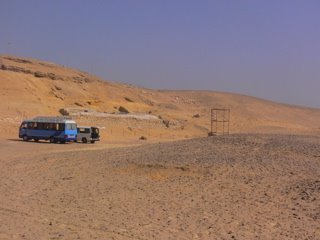
This last week we finally got a bit of a break and a friend of mine and I decided to take a couple of the horses out into the desert one morning. We were training these particular horses for desert work and a summer off has left muscles less than optimal. We rode out near the pyramids of Abu Sir, went around the back of them and headed for the Japanese Hill. Just inside the desert edge is a plateau that represents what was the banks of the Nile many millenia ago and there is what would have been an island, an extension of the plateau but cut off from the main part of it. This is known as the Japanese Hill and it is a site reknowned fo its view of the pyramids of Giza to the north and Sakkara AND Dahshur to the south. This is an astounding vista, but one that we don't enjoy during the day in the summer.

The Japanese Hill got its name because every summer for the past at least fifteen or more years teams of Japanese archaeologists have come to dig away at the top and the sides of the hill searching for some kind of artifacts. Last week I finally found out what they have been searching for. Apparently one of the sons of Ramses the Second (I believe it was...easy to confuse which Ramses) was an amateur archaeologist himself and spent quite a bit of time reconstructing temples that had been abandoned, and this is one of his efforts.

Cristina and I had been out with her gelding on a moonlight ride with friends at the beginning of the summer and it hadn't been the best of experiences. I felt especially bad about it because Aybek boards with me and I didn't take into account the fact that he hadn't spent much time in the desert in the first place, hadn't done much night riding in the second and was only used to being around my herd of horses in the third. Since that night, we've been working on all of these things and have been riding in the desert, riding at night, and riding with strangers, but not all at the same time. That will come later.

So finally we found a morning that was cool enough to venture out into the sand again after the summer's heat. The wind off the river was brisk and fresh. For a change the haze of pollution over the valley was blown south and it was only grey north towards the city. We took the horses up onto the plateau where they had to deal with extremely broken ground thanks to the army practicing bulldozing and the sandminers taking over from there. All of this was new to Aybek who was a rescue who had been taken from Hurghada as a 2+ yr old that had been used for hauling tourists up and down the beach. Since his rescue, he'd mainly spent time hanging around paddocks and sort of growing up...just a little as he is a very small horse. From the plateau we noticed the archaeologists working over on the Japanese Hill and decided to go around the base to see what they were digging up.

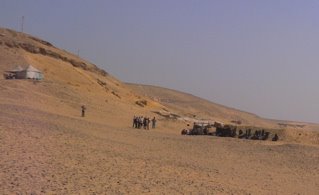
We didn't approach the camp, however. The Antiquities Service gets very nervous about things like that and rather than make them nervous we stay an easy 200 to 300 metres away. We could see the limestone wall against the hill that had been excavated over the past few years and the wonderful Agatha Christiesque tents perched on the hill for the university staff. It was about 10:30 am, roughly time for the breakfast break for people who start working a dawn, and the Egyptian workers were sitting in the shade having a bite to eat.

By the time we circled the hill and headed for the countryside, the air was beginning to heat up and we were extremely happy to hit the shade of the trees along the canals. A couple stretches for galloping and we were back home where the horses could be stripped down for a shower under the hose.

copyright 2006 Maryanne Stroud Gabbani